Discerning The Silent Presence
Discerning The Silent Presence
Discerning The Silent Presence
Category:
Category:
Apparatus
Apparatus
Service:
Service:
Research & Design
Research & Design
Year:
Year:
2024
2024
Credits
Ben Spong
Design Tutor
Stefan Lengen
Design Tutor
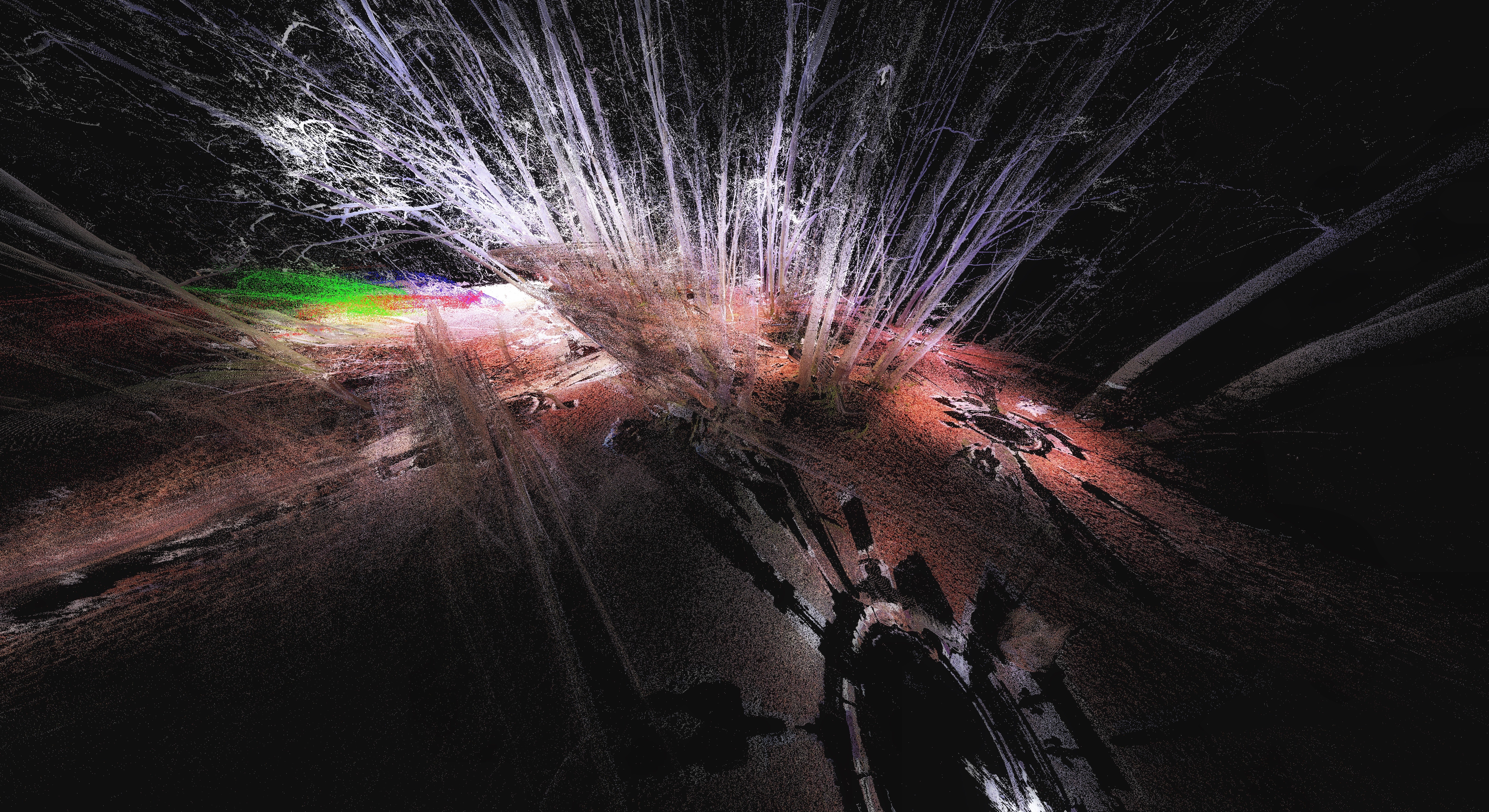
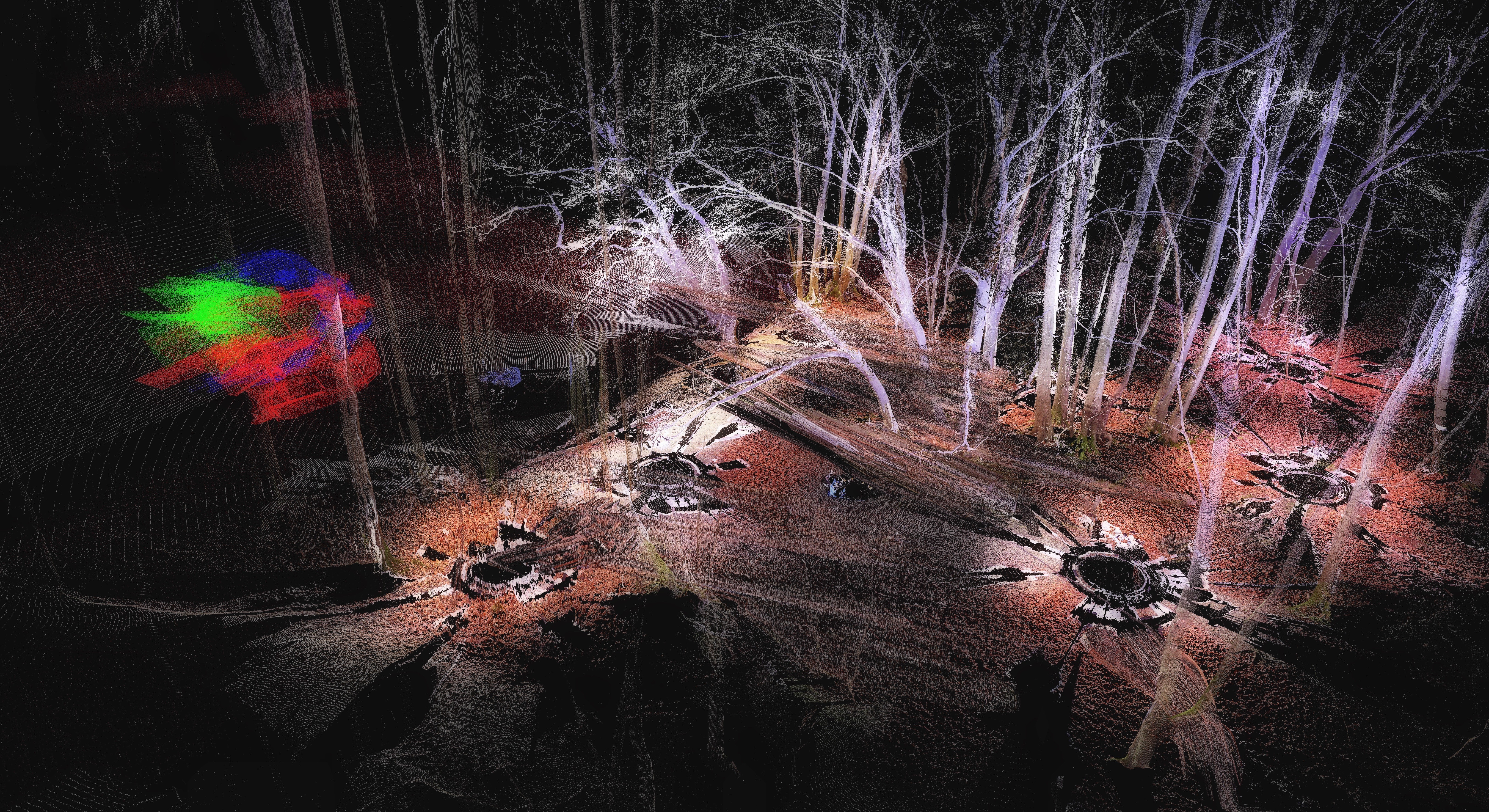
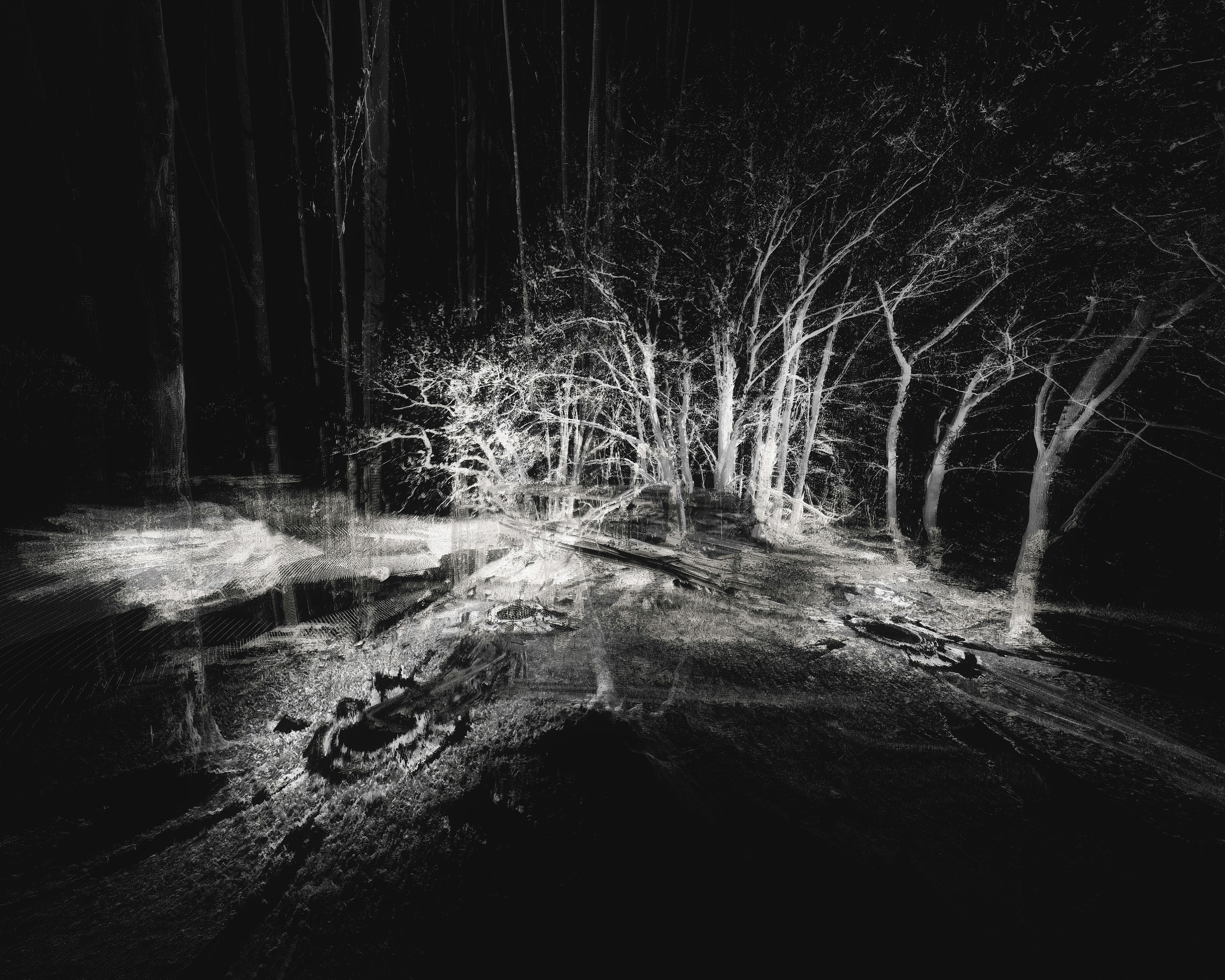
As light travels between the lenses and mirrors, the scan consistently deploys scale shifts, virtual extensions, and morphing geometries to disorient the sensor perception. These techniques challenge and reshape conventional conceptions of reality and its confines. Meanwhile, tangible events, documented fictions, and imagined scenarios intertwine to craft a complex narrative, blurring the line between authenticity and artifice. To obfuscate the demarcation between the represented and the factual within Epping Forest.
As light travels between the lenses and mirrors, the scan consistently deploys scale shifts, virtual extensions, and morphing geometries to disorient the sensor perception. These techniques challenge and reshape conventional conceptions of reality and its confines. Meanwhile, tangible events, documented fictions, and imagined scenarios intertwine to craft a complex narrative, blurring the line between authenticity and artifice. To obfuscate the demarcation between the represented and the factual within Epping Forest.
In this carefully staged collision of archaeology, surveillance culture, and speculative fiction, LIDAR becomes both narrator and unreliable witness. By exploiting the same techniques now embedded in autonomous vehicles and even smartphones, the project exposes how easily the rhetoric of positivist realism can be bent toward fabrication. Echoing Paul Virilio’s warning that every new optical tool carries the threat of distortion, Discerning the Silent Presence blurs the line between empirical evidence and engineered myth, challenging viewers to decide where reality ends and technological storytelling begins.
In this carefully staged collision of archaeology, surveillance culture, and speculative fiction, LIDAR becomes both narrator and unreliable witness. By exploiting the same techniques now embedded in autonomous vehicles and even smartphones, the project exposes how easily the rhetoric of positivist realism can be bent toward fabrication. Echoing Paul Virilio’s warning that every new optical tool carries the threat of distortion, Discerning the Silent Presence blurs the line between empirical evidence and engineered myth, challenging viewers to decide where reality ends and technological storytelling begins.
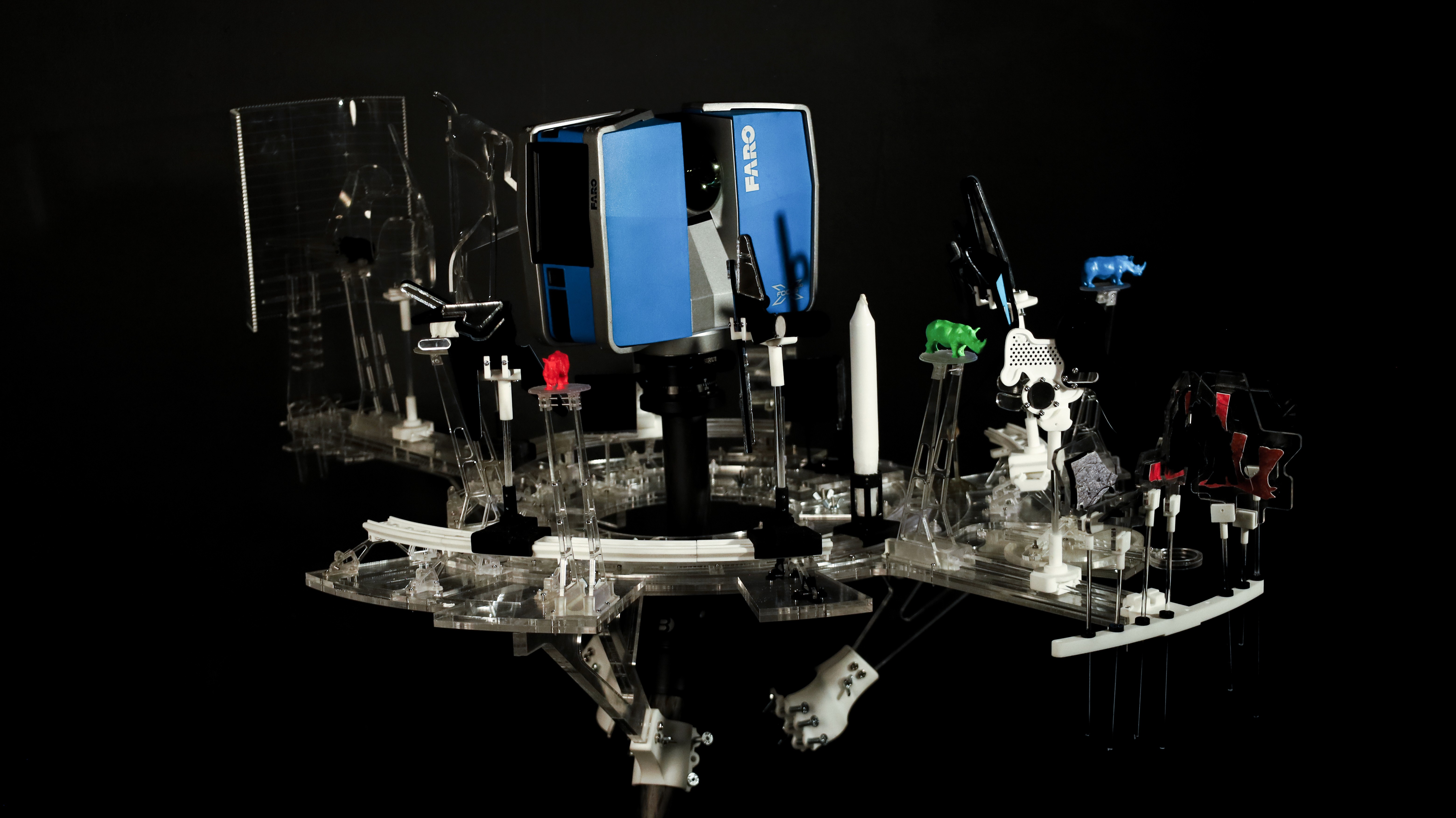
This apparatus develops an optical workflow for controlling LiDAR scan outcomes. The study isolates five adjustable variables—geometry, lighting conditions, color/texture, object position, and ambient shadow—and deploys a field “laboratory” in Epping Forest. Custom lenses and mirrors, mounted on tracked trolleys, are calibrated by angle and focal length. Early iterations use acrylic components and clear SLA prints; Pantheon Black (≈96% absorbance) is applied to selectively suppress returns and occlude views. To counter sunlight drift during the scanner’s slow 180-degree rotation, candle-lit reflectors stabilise reflection/refraction conditions.
This apparatus develops an optical workflow for controlling LiDAR scan outcomes. The study isolates five adjustable variables—geometry, lighting conditions, color/texture, object position, and ambient shadow—and deploys a field “laboratory” in Epping Forest. Custom lenses and mirrors, mounted on tracked trolleys, are calibrated by angle and focal length. Early iterations use acrylic components and clear SLA prints; Pantheon Black (≈96% absorbance) is applied to selectively suppress returns and occlude views. To counter sunlight drift during the scanner’s slow 180-degree rotation, candle-lit reflectors stabilise reflection/refraction conditions.
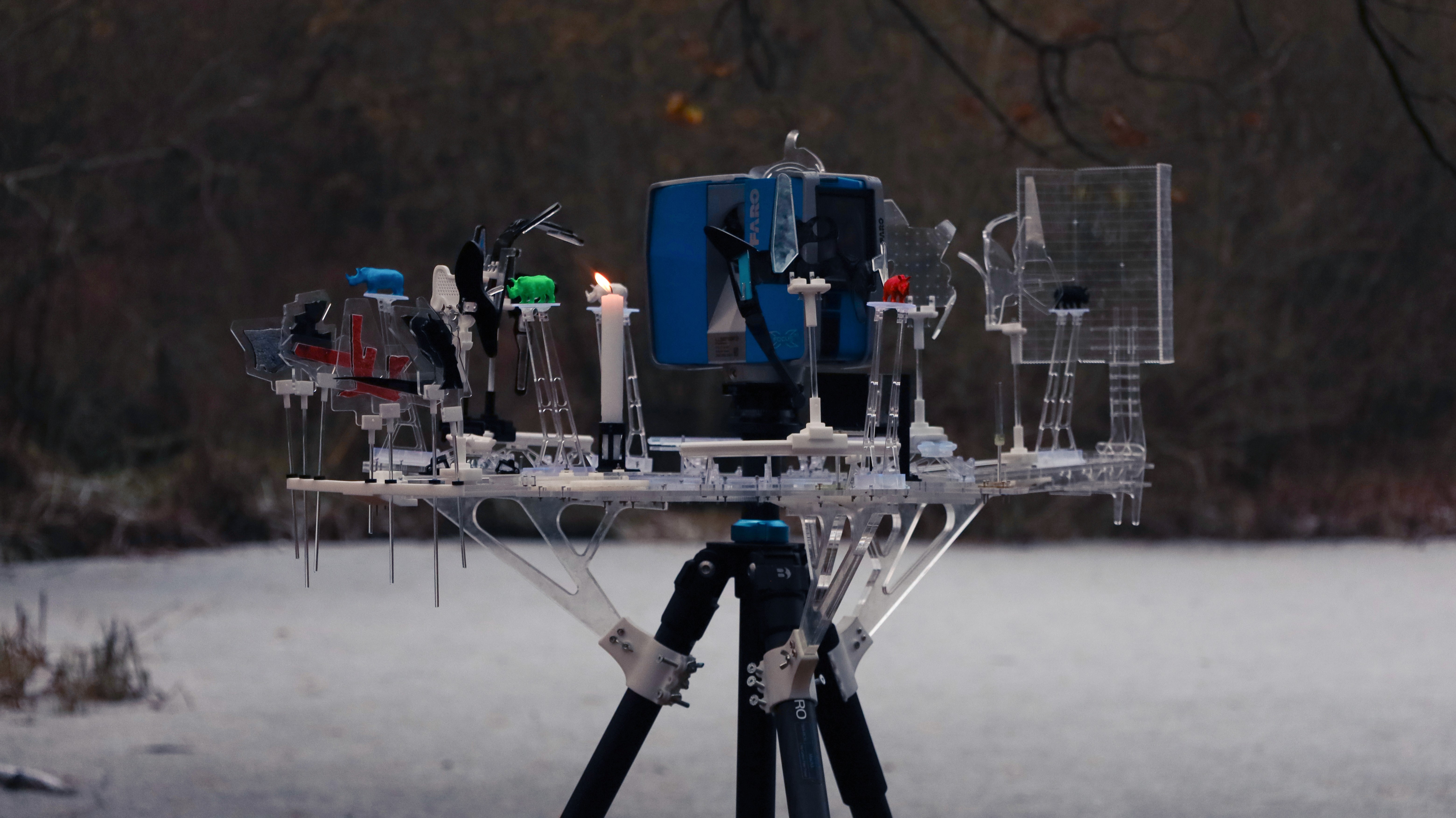
Mirror geometries are script-driven to respond to site scenarios—duplicating or redirecting branch structures and introducing view-blockers that remap surface readings. Five rhino targets (RGBI + black) serve as colour references and focal anchors to guarantee full coverage. At the core is a reverse-engineering algorithm that computes lens thickness, curvature, and orientation by tracing desired caustics and solving reflection/refraction chains. Deployed in situ, the optics steer arboreal forms toward spectral silhouettes, deliberately “bending” the point cloud.
Mirror geometries are script-driven to respond to site scenarios—duplicating or redirecting branch structures and introducing view-blockers that remap surface readings. Five rhino targets (RGBI + black) serve as colour references and focal anchors to guarantee full coverage. At the core is a reverse-engineering algorithm that computes lens thickness, curvature, and orientation by tracing desired caustics and solving reflection/refraction chains. Deployed in situ, the optics steer arboreal forms toward spectral silhouettes, deliberately “bending” the point cloud.